
I had the pleasure of hearing Danielle Linzer, Manager of Access and Community Programs at the Whitney Museum of American Art, speak at last year’s American Alliance of Museums conference. Over the last few years, Danielle has launched wonderful initiatives aimed at increasing the Whitney’s level of accessibility to people with disabilities. In this blog post, she focuses on these efforts. In a future post, she will further explore the museum’s community outreach programs and the inclusive planning process the Whitney has adopted in the lead up to the opening of the museum’s new building. –Rose
* * * *
Ironically, “community” is often used in museums as a euphemism for the very people who see our institutions as irrelevant and even elitist, while “access” refers to the people who are frequently excluded from full participation in our offerings. In access and community programs at the Whitney, we acknowledge that there are persistent barriers that prevent many audiences from engaging with the museum’s resources– these may be physical or communication barriers, or they may be economic, attitudinal, and perceptual. For museums to survive and thrive in the 21st century, it is essential to be perceived as welcoming institutions that embrace and keep pace with societal change.

After a few formative years in the Education Department at the Lower East Side Tenement Museum, I had the amazing luck to find myself working with the Whitney’s wonderful teen programs back in 2009. I witnessed firsthand the transformational impact that museums can have, and this understanding has become a driving force within my work. Contemporary artists grapple with many of the same issues that our modern communities do, and there is great value in connecting diverse new audiences to the museum’s resources. At the same time, a deep personal commitment to equality and inclusion holds me to the notion that access to art is a right, not a privilege.
To this end, we’ve been working to introduce a set of programs, policies, and relationships to make the Whitney a more accessible institution. We offer specialized programming and resources for people with disabilities, from verbal description and touch tours to gallery talks and educational videos in American Sign Language. We’re expanding our senior programs to work with individuals affected by dementia and their caregivers, and will soon be launching a new series of workshops for families with children on the autism spectrum. Just this fall, we collaborated with the Institute for Human Centered Design to introduce a ramp making our Sculpture Court accessible to wheelchair users for the first time, and we’ve been working towards improving digital access both online and onsite with assistance from the National Center for Accessible Media. These changes don’t happen overnight– they are tiny, incremental steps bringing us closer to our goal of providing the same opportunities and choices to all of our visitors. There’s also a snowball effect– once your museum begins to authentically engage new audiences, including people with disabilities, you become more aware of the barriers to participation that exist throughout your institution.
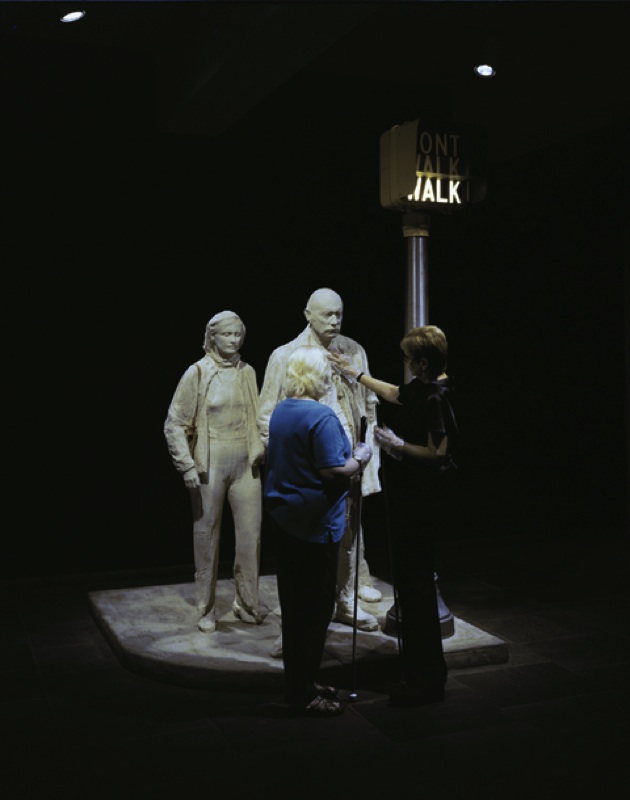
As a field we’ve evolved a set of standard practices for making certain aesthetic experiences accessible to people with and without disabilities– but contemporary artists work in unexpected and experimental modes that challenge our very definition of what art can be. Finding a balance between the Whitney’s mission to realize the visions of contemporary American artists and our responsibility to make the museum an inclusive, welcoming place is an ongoing challenge. It’s also what makes the job so exciting. We’ve embraced the principle that the art and ideas you encounter at the Whitney should be challenging, but the visitor experience should not.

To achieve this, collaboration is key, both inside the organization and with external stakeholders. A lot of my work has to do with building bridges with colleagues across the institution, and engaging them in the work of making the museum a more accessible place. I strive to act not only as an advocate for the needs of people with disabilities, but also as an educator, building capacity and knowledge in different departments. User testing is also essential– inviting advisors and individuals who have disabilities into your organization and asking for their input (and really listening to what they have to say) is a humbling and necessary practice. When developing new programs and reaching out to new audiences, co-creation of programming with partner organizations can help to ensure that the experiences you provide genuinely meet the needs of your participants.

We’ve made real progress over the past few years in making the museum more accessible, though we have a long way to go. The Whitney is currently on the cusp of great change– in 2011, we broke ground on a beautiful new museum building nestled at the southern end of the High Line in downtown Manhattan. As soaring steel beams cast new shadows across the West Side Highway, a sense of tremendous opportunity and responsibility looms. “If you build it, they will come” is generally not true of accessibility efforts– they require a sustained commitment to engaging stakeholders, building trusting relationships, and continually evaluating and refining your efforts. Stay tuned to learn more about our efforts as we move the idea of the Whitney into the future.
* * * *
Danielle Linzer is the Manager of Access and Community Programs at the Whitney Museum of American Art. She oversees institutional compliance and educational programs for people with disabilities at the Whitney, as well as community-based partnerships and outreach strategies for audiences that have traditionally been underserved by cultural organizations. In 2012 Danielle received an Emerging Leader award from the Leadership Exchange in Arts and Disability conference, organized by the Kennedy Center for the Performing Arts. Her digital media accessibility initiative, The Vlog Project, has been honored with a 2011 Jodi Commendation for accessible digital culture, a 2012 bronze Muse Award from the American Alliance of Museums, and a 2012 Best of the Web award from the Museums and the Web annual conference. Danielle is currently the Co-Chair of the Museum Access Consortium, a membership organization that strives to enable people with disabilities to access cultural facilities of all types.
Prior to joining the Whitney in January 2009, Danielle served as the Education Coordinator at the Lower East Side Tenement Museum, where she oversaw school and public programs and managed programs and services for people with disabilities. Before entering the museum field, Danielle worked in documentary film, community organizing, social service, and photographic arts. Danielle received her B.A. from the University of Pennsylvania and holds an M.S. in Leadership in Museum Education from Bank Street College.
————————————————–


Leave a Reply